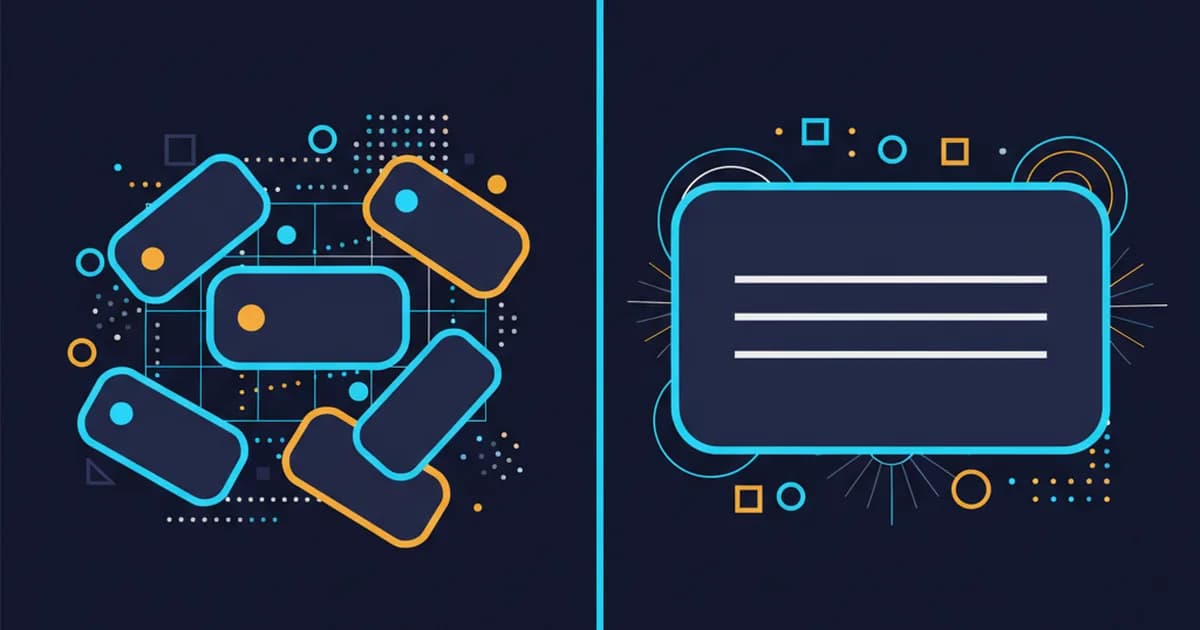
If your team handles real customer questions across WhatsApp, Instagram, or Messenger, an AI inbox is usually the better choice. AI chatbots are still useful for narrow, predictable flows. The difference is whether the tool reads context or forces customers through a script.
The Quick Answer#
An AI chatbot is a rule-based system that follows a fixed decision tree. "Press 1 for sales, press 2 for support." Every customer goes through the same paths. When they go off-script, it breaks.
An AI inbox uses large language models (LLMs) to read each message and draft a contextual reply. It handles novel questions, custom requests, and nuance. It sounds like a real person because it is actually reading what the customer wrote.
Both tools automate messaging, but they solve different jobs. A chatbot routes. An AI inbox replies.
How do AI chatbots actually work?#
Most "AI chatbots" are not really AI. They are decision trees. Here is what is happening under the hood:
- Customer sends a message.
- The bot scans for keywords ("pricing", "hours", "support").
- If it finds a match, it sends the canned response tied to that keyword.
- If it does not find a match, it shows a menu or escalates to a human.
This is fine for narrow use cases. Lead capture forms. Order-status lookups. Booking widgets. But the moment a customer asks something nuanced ("does the size 8 in the gray run small?"), the bot is stuck.
Real chatbots have one job. They route. They lookup. They do not converse.
How does an AI inbox work?#
AI inboxes use large language models (GPT-4, Claude, etc.) plus your business knowledge to generate replies. Here is the actual flow:
- Customer sends a message.
- The AI pulls the conversation history, the customer's profile, and your business knowledge base.
- The LLM generates a contextual reply, in your brand voice.
- Your team reviews the draft (one click to send, one click to edit), or it auto-sends for pre-approved categories.
- The reply lands in the customer's WhatsApp, Instagram, or Messenger thread within seconds.
This is why AI replies outperform chatbots: every message gets a tailored response, not a canned one.
AI chatbot vs AI inbox: side-by-side comparison#
| Capability | AI Chatbot | AI Inbox |
|---|---|---|
| Handles novel questions | No | Yes |
| Brand voice matching | Limited to templates | Adapts based on training data |
| Multi-channel (Instagram, WhatsApp, Messenger) | Sometimes | Native |
| Conversation memory across sessions | Rare | Standard |
| Human handoff with full context | Hit or miss | Built-in |
| Lead qualification | Form-based | Conversational |
| Best for | FAQ deflection | Sales and support |
| Typical pricing model | Often per contact or per conversation | Varies: per seat, per conversation, or flat plan |
When is a chatbot the right choice?#
Chatbots are not dead. They are just narrow. Use them for:
- Lead capture forms. "What is your name? What is your email?" Linear, predictable, fast.
- Status lookups. "Where is my order?" The bot queries your database, returns the answer.
- Appointment booking widgets. Calendar slot picker. Simple, structured, no conversation needed.
- Intent routing. "Is this sales or support?" One question, two paths.
If the conversation is predictable and structured, a chatbot works. If the conversation is open-ended, you need the inbox.
When do you need an AI inbox instead?#
AI inboxes are the right call when:
- You sell over chat. Customers ask custom questions about products, pricing, fit, availability. Chatbots cannot answer these. AI inboxes can.
- You handle support over messaging. Real support requires reading the customer, understanding context, and adapting. Decision trees fail here every time.
- You follow up with leads. Effective follow-up references the original conversation. Chatbots cannot remember it. AI inboxes do, automatically. See smart follow-ups.
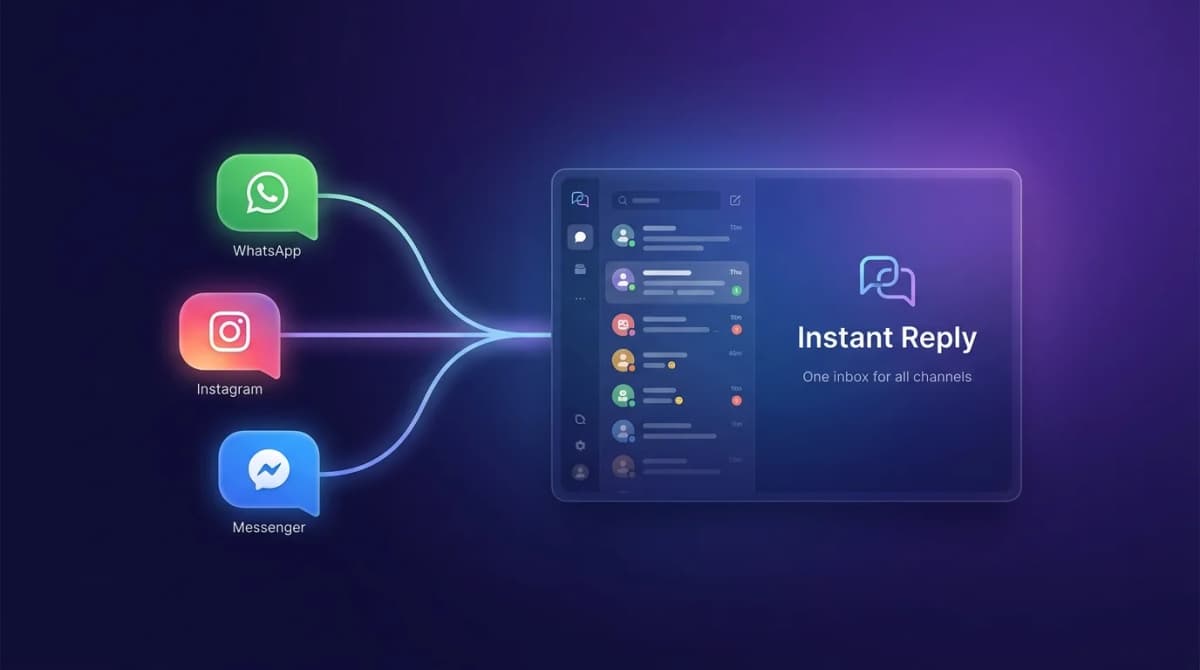
- You run multiple channels. A customer might message you on Instagram, then WhatsApp two weeks later. An AI inbox unifies that history in a single inbox. Chatbots do not.
Which performs better for sales and support?#
Teams usually switch when they realize customers are asking questions that do not fit a menu. That is where an AI inbox pulls ahead. It reads the question, checks the conversation history, and drafts a reply that fits the exact situation.
- Response time: an AI inbox drafts a reply as soon as the message arrives, instead of waiting for a person to type it or for a menu to match.
- Resolution: more routine questions can be handled without forcing the customer through a menu.
- Customer experience: replies can reference products, policies, and prior messages instead of sending the same canned answer.
- Conversion: fewer conversations stall because the customer asked a question the flow builder did not anticipate.
For a business doing $50,000 a month in revenue, even a modest conversion lift on the messaging channel can be material. The bigger point is operational: fewer dropped conversations, faster first replies, and fewer customers getting stuck in a dead-end flow.
The Hidden Cost of the Wrong Choice#
Deploying a chatbot when you need an inbox damages your brand. Every awkward "I did not understand that, please rephrase" is a customer thinking "I would rather call a human" or worse, "I will buy from someone else."
Conversely, deploying a full AI inbox when you just need a lead-capture form is overkill. You pay for capability you do not use.
The cost of misdiagnosing is real. Pick based on the conversation type, not the marketing copy.
Hybrid Models: When You Use Both#
Mature teams run both:
- Chatbot at the top of the funnel for lead capture and intent routing.
- AI inbox for the body of the conversation once intent is clear.
- Human takeover for high-value or complex conversations.
This is the 2026 best practice. Use each tool where it wins. Do not force one to do the other's job.
How to Choose: The 3-Question Test#
Ask yourself these three questions:
- Do customers ask the same 5-10 questions every time, with no variation? Chatbot works.
- Do customers expect a human-like reply that knows your products and your tone? AI inbox.
- Are you running messaging across more than one channel (Instagram + WhatsApp + Messenger)? AI inbox.
Two out of three = AI inbox. One out of three = chatbot. Three out of three = AI inbox, no exceptions.
The Verdict#
If you are running customer messaging in 2026 and you want it to scale without losing the human feel, you want an AI inbox. Chatbots have a place, but it is narrow. The inbox is the operating system for modern messaging-driven businesses.
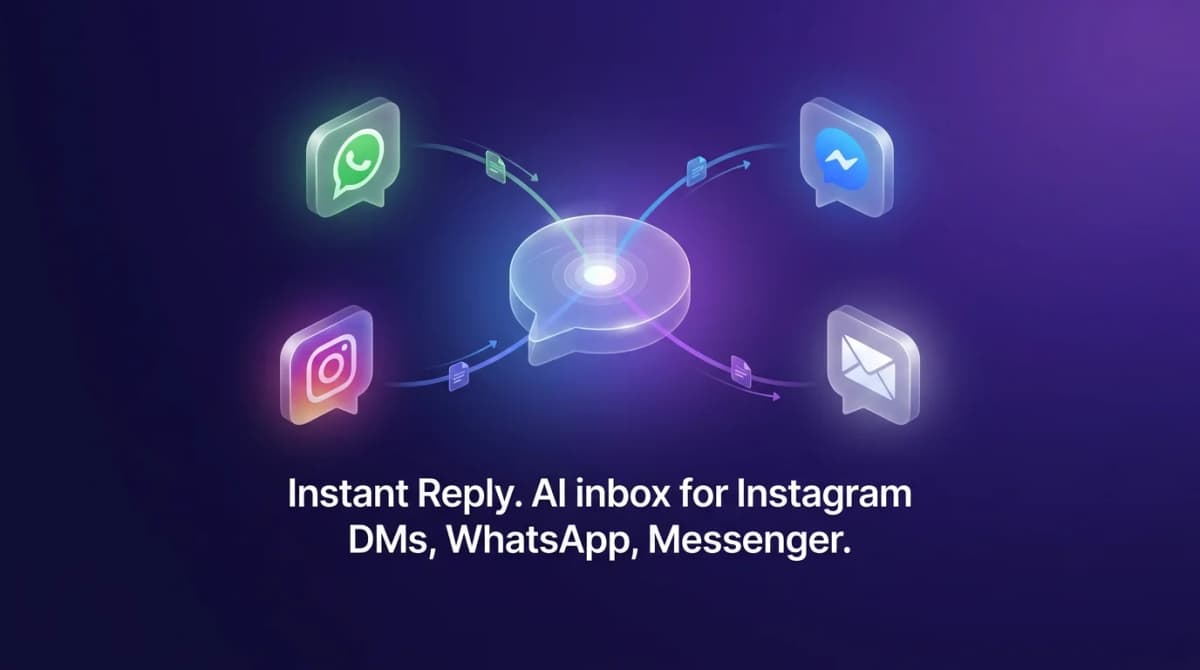
Instant Reply is an AI inbox built for Instagram, WhatsApp, and Messenger. Trains on your business in minutes. Drafts replies in seconds. Sounds like you. See it shipped as a WhatsApp AI chatbot, an AI sales assistant, or an AI customer support brain, all running on the same inbox. Start your free trial and compare it to whatever bot you are running today, or try the live demo first.