If a lead goes quiet after the first reply, the best follow-up rule is simple: send five messages over 30 days on the same channel they used, and stop the moment they reply. Most ghosted leads are not rejecting you. They got distracted.
Why do leads go quiet after showing interest?#
A lead messages you on Instagram. "Hey, how much for the starter package?" You reply four hours later. Silence. They are gone. You think they were not serious. You are wrong.
They were serious. They were also busy. They saw your reply while driving, told themselves they would respond later, and never did. Not because they do not want your product. Because life happened.
In most cases, silence means bad timing, not a dead deal. That is why a clear follow-up system beats one heroic first reply.
How many times should you follow up with a lead?#
Many sales teams stop after one reply. That is usually too early for social leads, where the buyer may be comparing options, checking with a partner, or simply busy.
On social media, it is even worse. Most businesses send one reply and wait. If the lead does not respond, the conversation dies. No follow-up. No second message. Just a lost sale sitting in your DM inbox.
The practical rule is five touches over 30 days: day 1, day 3, day 7, day 14, and day 30. That cadence gives you enough chances to catch a busy buyer without turning into background noise.
What is the best follow-up cadence for ghosted leads?#
Timing matters more than wording. A perfect message sent at the wrong time gets ignored. A decent message sent at the right time gets a reply.
Here is the follow-up timing framework that works:
- First follow-up: 24 hours. Short and casual. "Hey, just wanted to make sure you saw my message. Let me know if you have any questions!"
- Second follow-up: 3 days. Add value. Share a relevant tip, testimonial, or resource. Show you are not just chasing them.
- Third follow-up: 7 days. Direct and honest. "Still interested in [thing they asked about]? Happy to help whenever you are ready."
- Fourth follow-up: 14 days. Offer something. A discount. A free consultation. A limited-time deal. Give them a reason to act now.
- Fifth follow-up: 30 days. The graceful close. "Hey, I do not want to bother you. If you are ever interested in [thing], I am here. No pressure."
Five messages over 30 days is enough for most service, SaaS, and ecommerce conversations. If they reply, the sequence ends immediately and the conversation moves back to a human or an AI-assisted inbox.
Why You Cannot Do This Manually#
Let's do the math. Say you get 20 new leads per week on social media. Each one needs up to five follow-ups. That is 100 follow-up messages per week, each with different timing. Plus you need to track who responded, who did not, and who said no.
After a month, you are juggling 400 follow-up threads. No human can manage that consistently. You will forget. You will miss follow-ups. You will lose leads that were ready to buy.
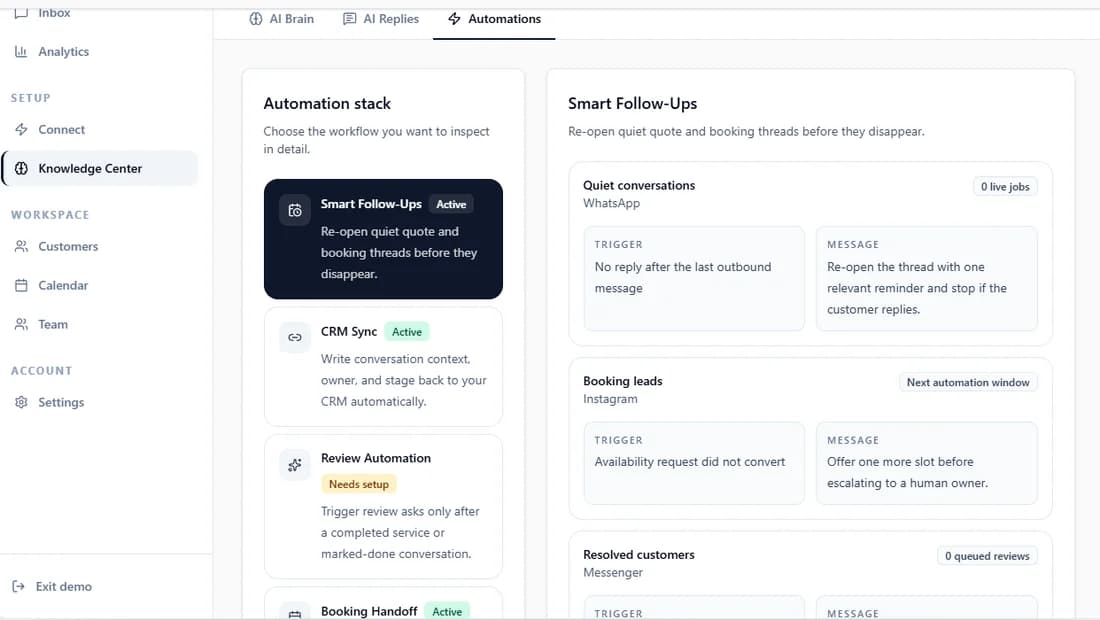
Manual follow-up breaks at volume. A proper smart follow-up system tracks every quiet conversation, times each next step, and stops the automation when the lead comes back.
How Lead Follow-Up Automation Works#
Good follow-up automation does four things:
1. Tracks every conversation#
When a lead messages you, the system logs it. When they go quiet, the clock starts. No lead falls through the cracks because you forgot to check your DMs. Lead management software ties every DM to a contact profile so the history stays one click away.
2. Sends follow-ups on schedule#
Based on your timing rules, the system queues up follow-up messages. Day 1, day 3, day 7, day 14, day 30. Automatic. Consistent. Every single time.
3. Stops when they reply#
This is crucial. The moment a lead responds, the follow-up sequence stops. They get routed to you or your team for a real conversation. Nobody gets an awkward "just checking in" message right after they already replied.
4. Personalizes at scale#
Each follow-up references the original conversation. "Hey, you asked about our photography packages last week." Not "Dear customer, we noticed you have not replied to our previous communication." Context makes the difference between helpful and spammy.
The Revenue Impact of Consistent Follow-Up#
Follow-up revenue depends on your lead volume, deal size, and close rate. The reason the upside exists is simple: some quiet leads were still interested, but the timing was wrong. A good follow-up system gives those buyers a clean path back into the conversation.
For a business with an average deal size of $500 and 80 leads per month:
- Without follow-up: 8 sales = $4,000
- With follow-up: 18 sales = $9,000
Treat that as a model, not a promise. Replace the inputs with your own numbers before you decide whether automation or more staff is the better fix.
Cross-Channel Follow-Up: Same Channel, Better Results#
Follow up on the channel they used. Instagram lead gets Instagram follow-ups. WhatsApp lead gets WhatsApp follow-ups. Messenger lead gets Messenger follow-ups. Cross-channel chasing usually feels invasive and performs worse because the lead never opted into that second channel.
An exception is when the lead explicitly gives you another contact route and expects you to use it. Otherwise, stay in the same thread and keep the experience clean. A unified inbox helps your team keep that context without tab-switching.
What to Send in Each Follow-Up#
Generic templates feel like spam. Specific references feel like service. Here are real examples:
Day 1 follow-up (the soft nudge)#
"Hey Sarah, just making sure you saw the pricing I sent on the starter package. Happy to answer any questions."
Day 3 follow-up (add value)#
"Quick one: I saw this example from a client in your space and thought it matched what you asked about. The starter package fits this use case well. Want me to send it over?"
Day 7 follow-up (direct)#
"Hey Sarah, is the starter package still on your radar? If timing is off, no problem. I just want to know whether to keep your slot open."
Day 14 follow-up (offer)#
"Quick heads-up: we have a few starter slots opening next week at the current pricing. If you want one, here is the link: [/register]."
Day 30 follow-up (graceful close)#
"Sarah, I will stop chasing. If you are ever ready, just message and I will pick it back up. No pressure."
Stop Letting Warm Leads Go Cold#
Every lead who ghosts you is money sitting on the table. Not because they are not interested. Because nobody reminded them. Fix the follow-up and you fix the revenue.
Instant Reply tracks every conversation across Instagram, WhatsApp, and Messenger. When leads go quiet, it queues the next follow-up on your schedule with the timing, template, and stop rules you set. No more lost leads. No more forgotten DMs. Start your free trial and recover revenue you have been leaving behind, or see how this beats manual channel switching.